Income and wealth
Income is the flow of money to the factors of production, e.g., rent, interest, wages, and profit. Wealth is the stock of assets possessed by an entity, e.g., property, shares, bonds, etc. Wealth generates income, e.g., rent from property.
Distribution of income or wealth
This is the spread of income or wealth among different individuals, classes or groups within a country. It shows how much income or wealth an individual has in relation to others in the society.
The distribution may be equal or unequal. Equality or equal distribution of income or wealth occurs when different individuals or groups have the same amount of income or wealth, regardless of age, gender, race or occupation. Inequality is a situation in which income or wealth is unevenly distributed in a country.
Equitable distribution occurs when the income distribution is fair to all. This occurs when all citizens have the same opportunity to acquire assets and generate income. Equitable distribution is part of normative economics, as what is fair to one person may not be fair to another. In other words, fairness is subjective as it is based on value judgement.
Measurement of income inequality
Lorenz Curve
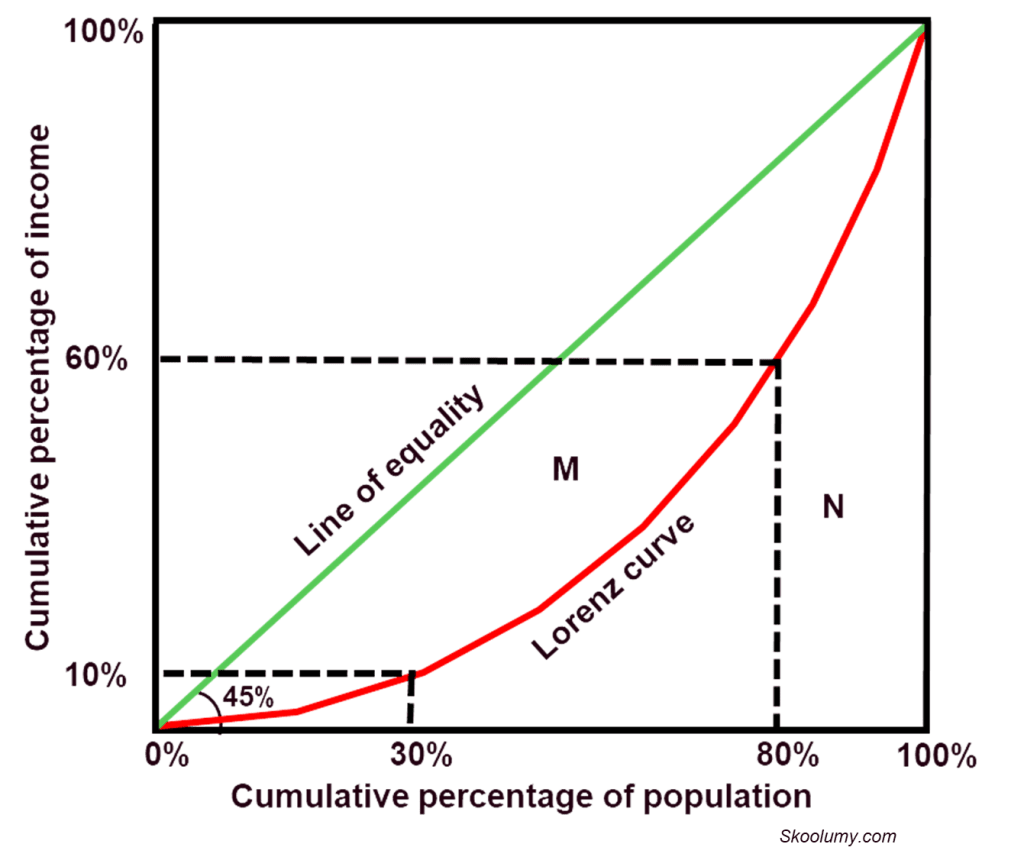
The Lorenz curve is a graph that shows the percentage of all incomes (or wealth) possessed by households at successive income (or wealth) levels. It plots the cumulative number of households against the cumulative income (or wealth). A 45-degree line is included to help determine the extent of inequality (Figure 1 below). The 45-degree line is a line of equality. The distance between the bowed-out Lorenz curve and the line of equality is the amount of inequality. The farther away the Lorenz curve is from the line of equality, the greater the level of inequality in the economy. The closer, the less inequality in the country.
Figure 1: The Lorenz curve
In Figure 2 below, the lowest 30% of the population controls 10% of the country’s total income while 80% of the population has 60% of the total income. The top 20% of the population (100% minus 80%) controls 40% of total income (100% minus 60%).
Figure 2: Measuring inequality with Lorenz curve
Gini Coefficient
It is a numerical measure of inequality that is calculated from the Lorenz curve. It is obtained by dividing the area between the line of equality and the Lorenz curve (M in Figure 2 above) by the total area of the triangle under the 45-degree line (M + N). Therefore, the Gini coefficient is M/(M+N).
The Gini coefficient is a number between 0 (0%) and 1 (100%). A value of zero (or 0%) implies there is perfect equality, that is, people have the same income or wealth. A value of 1 (or 100%) shows perfect inequality where all the income or wealth in the society belongs to just one person.
Causes of inequality
Aptitude
This is either the mental or physical capacity to perform a certain job or task that pays well than others. The capacity may be learned and/or enhanced through education and training, e.g., engineering, surgery, etc. Heredity and environment can also influence the development of certain attributes that assist in the performance of certain tasks that pay well, e.g. sports.
Possession of wealth
People who have a substantial amount of wealth, either physical, such as land, or financial, such as shares, receive a lot of income in the form of rents or dividends.
Inheritance
Some people inherit wealth from their families and have more income than others. These people were lucky to be born into wealthy families or married to rich husbands.
Discrimination
Some earn more or have acquired more wealth than others because they have been given more opportunities than others based on their race, gender, age, religion or nationality. Consequently, they get higher pay, benefits and promotion than their peers. These are not based on the productivity of the workers.
Trade union membership
Unionised workers tend to earn higher than non-unionised workers because the trade union can exercise monopoly power and collectively negotiate higher pay for its members. This is one of the reasons for wage differentials in the labour market.
Nature of the job
The nature of some jobs makes them unattractive to many people. So the demand for them exceeds the supply, thereby making them command higher wages than other jobs. Examples are dangerous jobs like commercial diver, forester, police officer and firefighter.
Unemployment
This is one of the major causes of income inequality. Unemployed people earn no income and rely on benefits from the government, which are not enough for a decent living standard. The gap between the unemployed and the employed keeps getting wider as benefits do not get increased as wages.
Monopoly power
Monopolies enrich their owners at the expense of the consumers by charging exorbitant prices that ensure that profits distributed to their shareholders are as high as possible. They have the power to turn consumer surplus into producer surplus by charging different prices for the same product based on the consumers’ ability to pay (price discrimination). They end up making a lot of sales and profit to the detriment of the consumers while benefitting their owners.
Technology
The knowledge of new technologies is contributing to rising income and employment, e.g., artificial intelligence, cloud computing, data science, etc. It is also widening the income gap between those who possess them and those who do not.
Advantages of inequality
Hard work
Inequality encourages people to work harder to earn more since they know this can increase their income and bridge the gap between them and the high-income earners in the society. They also make an effort to acquire more skills to improve their earning capacity. This can benefit the economy by increasing the total output of the country. An egalitarian society promotes laziness and a lack of self-reliance.
Promoting entrepreneurship
The market economy promotes entrepreneurship even though there may be inequality. People become more adventurous and set up new businesses. There is competition that promotes innovation and invention.
Reduced unemployment
Jobs are created as people seek out new businesses. The standard of living of those who become employed will rise as they earn income to meet their needs.
Higher Gross Domestic Product (GDP)
Because people are motivated to work harder and set up businesses, the country would experience economic growth. That is to say, the total output of the economy will increase.
Disadvantages of inequality
Market failure
Inequality leads to inefficient utilisation of resources in the market economy. The amount of income an individual has determines the amount of goods he or she consumes in a market economy. Those with less income consume fewer goods and may have a low standard of living.
Tension and crisis
The wide gap between low-income and high-income groups can lead to protests and rioting by those who can barely cater to their needs. This can ultimately bring down the government if it is perceived that it is not doing enough to alleviate their suffering; they may violently seek a change of government through their actions.
Higher crime rate
Many may resort to crimes to satisfy their wants. This will create further problems for the government, such as increased spending on maintaining law and order.
Increased government spending
The government has to spend more to redistribute income. Benefits have to be paid to assist the poor and the unemployed. Subsidised housing, education and other services have to be provided by the government for low-income earners. This may result in a budget deficit and increased borrowing by the government.
Capital flight
Widespread inequality in an economy could make the government increase the tax rate paid by the rich to have enough money to provide more public services for the benefit of the low-income individuals. High-income earners may have to move their investments to a more conducive environment.
Policies to redistribute income and wealth
Taxation
The use of progressive tax is capable of redistributing income because as income increases, the proportion of people’s income paid as tax increases (tax rate). The tax rate decreases as income decreases. Therefore, the rich are proportionally taxed more while the low-income earners pay a lower tax rate. A progressive tax reduces the income of the rich. The more money collected from high-income earners can then be used to pay benefits or provide services for the poor, e.g., education, healthcare, etc.
A regressive tax, on the other hand, does not redistribute income from the rich; rather, it takes more from the poor because as income decreases tax rate increases. An example is Value-Added Tax (VAT) or General Sales Tax (GST); VAT or GST is a fixed percentage of the price of the product or a specific amount per unit, but it forms a bigger proportion of income as income decreases.
A proportional tax is fair to all as everyone pays the same tax rate irrespective of income level, e.g., corporation tax.
The government can impose an inheritance tax on those who inherit assets from others to redistribute income. Taxes can also be levied on profit made when an asset is sold (capital gains tax).
The income and substitution effects of taxation
The net effect of increasing tax is determined by the substitution effect and the income effect. Because taxes reduce disposable income, people may have to work for more hours to compensate for a reduced income. This is the income effect.
High taxation may encourage people to substitute leisure for work and work less as disposable income has gone down (substitution effect). For a low-income earner, the substitution effect is stronger than the income effect; so, tax is not a disincentive to work as they work more even if taxes are going up. A high-income earner, on the other hand, will reduce the hours of work as taxes increase because the income effect is stronger than the substitution effect. This person will, therefore, work less as taxes are increased. High income tax can also lead to relocation to a low-tax country.
Benefits
Benefits can be in the form of monetary payments or the provision of certain products free of charge or at subsidised prices.
Monetary benefits
The government makes a direct payment, which can be a grant or a low-interest loan facility. Some benefits are paid to only those with low income to support their income or help them afford some items, e.g., housing benefits, food vouchers, fuel allowances, etc. These are known means-tested benefits. They are directed to those in need.
Some benefits can be claimed regardless of the income of the recipient. These are called universal benefits, e.g., child benefits, state pensions, unemployment benefits, incapacity allowances and sickness allowances.
Non-monetary benefits
These involve the provision of free or subsidised products by the government. These are also known as benefits-in-kind, e.g., healthcare and education. These services are often available to everyone. But they help redistribute income since they form a big percentage of poor people’s income. They help increase the capacity of the poor to earn more income.
Effect of benefits
Benefits may not be claimed because of ignorance, reluctance or inability to meet the stipulated conditions. Reliance on benefits can make people find it difficult to look for jobs, thereby relying on the insufficient benefits they receive from the government (poverty trap).
Benefits require a substantial amount of financial resources on the part of the government, especially if it is a universal benefit that has to be paid regardless of income.
Minimum wage
The government stipulates a minimum wage through legislation for the benefit of low-paid employees. This can motivate workers to be more productive. However, those who are not employed will not benefit from the minimum wage. It is, therefore, a limited solution to the problem of poverty in the country.
A minimum wage may force businesses to cut jobs since it adds to their labor cost unless the rise in productivity outweighs the additional wage costs.
Anti-discrimination legislation
The government can promulgate laws against discrimination so that everyone has equal opportunities to be gainfully employed. Employment, wages and benefits must not be based on gender, religion, age, race, nationality and disability. Personal knowledge and job-related abilities are the primary factors to be considered for offering people jobs.