
Can you buy happiness with your money? The answer to that oft-asked question is not straightforward. Happiness measures well-being. When you are happy, you are satisfied with your life. It has become a key metric for measuring the effectiveness of government policies. If people are not happy, government policy is not improving welfare.
Why does money make people happy?
If you are happy after consuming a product, it means you derive some satisfaction or joy from using the product or service. Economists call it utility. While it is impossible to directly consume money, it can be used to obtain things that make people happy. This suggests that money can make you happy by giving you access to basic goods and services, such as food, healthcare, housing, and education. These products make people happy or improve their well-being. That is why one of the priorities of the government is the creation of jobs so that people can earn a decent income to purchase those basic goods and services. The government attaches importance to welfare and provides education, healthcare or housing at a low cost or free of charge.
Why does money not make people happy?
Happiness is beyond material comfort
Economics recognises that happiness depends on more than money. Non-monetary factors such as health, relationships, safety, job satisfaction, work-life balance, and personal freedom are some of the non-monetary factors that can make people happy. That is why an individual might reject a high-paying job that gives no time for leisure or career advancement.
While your level of material comfort can indicate a happy or fulfilled life, continuous or total happiness transcends material possessions. South Korea, a high-income country, has a high suicide rate despite its high living standards. In contrast, several low-income countries have a very low suicide rate, even though the level of deprivation is high. This means that happiness goes beyond the goods and services you enjoy.
Some things that money cannot buy contribute to the level of dissatisfaction if they are lacking. If you live, for example, in a place where you are always subjected to discrimination, you will not be happy no matter the level of material comfort you enjoy. Likewise, living in isolation can cause unhappiness even though it is a non-monetary factor.
If a person perceives himself to be poorer than others in the same society, he may become unhappy no matter how much money he has in absolute terms. He is sad even if his income is rising because he sees himself as worse off. Therefore, if economic growth only benefits one group, others who feel left behind become unhappy. This is why governments should formulate policies to ensure every group in the society benefits from growth to improve national well-being or happiness.
The law of diminishing marginal utility
According to the law of diminishing marginal utility, the satisfaction from every extra unit keeps falling as you continue to consume additional units of a product. This is why satisfaction from every extra unit of money keeps dropping beyond a certain income level.
As income rises, every extra unit of money provides less extra satisfaction than the previous one. One can buy more necessities with the first increase in income. Further increase in income can help buy luxury products, which add little to overall happiness. In other words, money can only satisfy up to a certain level after which the joy it provides declines. For example, making your first $1 million is a milestone achievement that makes you elated and proud. But the euphoria fades when you make the next $1 million, as it does not give the same amount of happiness, joy or satisfaction as the previous $1 million.
Even the government understands the law of diminishing marginal utility. It adopts a progressive tax system in which the tax rate rises as income rises. Because the happiness that the extra income gives is declining, the rich care less if the extra income attracts a higher tax rate. This enables the government to raise a lot of revenue for providing services such as education and healthcare.
The impact of money on happiness after a certain point is weak. There are many high-income earners experiencing anxiety, dissatisfaction or despair. This shows that money alone does not guarantee well-being.
Backward-bending individual supply curve
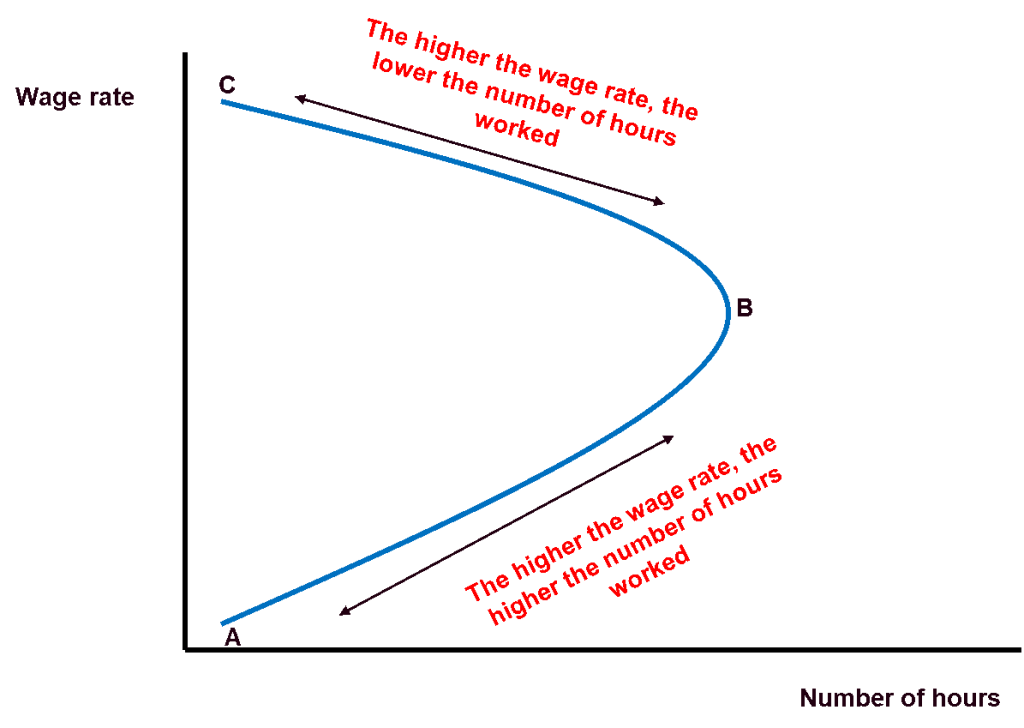
The supply curve of an individual can also be used to show that more money doesn’t translate to more happiness. A person who earns a little money will be motivated or happy to earn more because his income is hardly enough for his wants. He will sacrifice leisure to work for more hours if the wage rate is raised. He is always delighted by any opportunity to earn more because it increases his purchasing power. However, after a certain level, workers tend to reduce their working hours to enjoy more leisure. Raising the wage rate after that point doesn’t make them happier, because they are already financially stable or comfortable. Leisure gives them more happiness than the extra money they will earn by working more hours.
For low income earners money can buy happiness or increase satisfaction via higher purchasing power. There is always a strong relationship between money and happiness if a person is on low income because more money can bring about a significant improvement in standard of living. In addition, more money earns the low-income earner respect, gives him stability and secures his relationship.
In conclusion, money alone cannot guarantee lasting happiness. The happiness from an increase in money is temporary. Happiness quickly returns to the level it was before the increment. Although it plays a significant role in achieving happiness, money is not an end in itself. Income growth must be combined with non-monetary factors, like equality, to guarantee national happiness.