Meaning of market failure
Market failure occurs when the free market (market economic system) does not allocate resources optimally. The price mechanism, a major feature of the market economy, is expected to allocate resources in the most desirable and efficient manner. Despite the profit motive that prevails in a privately driven or market economy, scarce resources may not be used in the interest of the society.
Market failure may be total, in which case the operators of the economy do not produce a product at all owing to difficulty in making a profit from the provision, e.g., roads, streetlights, etc. The market produces too much or too little of a product when there is a partial market failure.
Though it does not play a major role in a market economy, the government often intervenes to correct market failure. There is no guarantee that government intervention will always work. Sometimes, the government makes the situation worse than it was initially. This is known as government failure.
Causes of market failure
The reasons why the market economic system fails to allocate resources efficiently are explained below.
Externalities
Externalities are the effects of the consumption or production of an economic agent on another economic agent. The market economy is driven by the decisions of private firms and consumers. However, both the consumers and producers do not take into consideration the full costs and benefits of their decisions. There are four types of externalities in a free market, namely positive production externalities, negative production externalities, positive consumption externalities and negative consumption externalities.
A positive production externality is a benefit accruing to other members of the society from productive activities of a firm, e.g., new vaccines, open source technology and new business establishment. The adverse effects of production on third parties are called negative production externalities, e.g., air pollution, water pollution, destruction of wildlife habitat, traffic congestion, etc.
Positive consumption externality is the benefit that a person derives from another person’s consumption, e.g. a vaccinated person does not spread communicable disease to others, walking reduces pollution from car use, education benefits the society by reducing crime rate, etc. Negative consumption externalities are the costs or adverse effects of consumption on the society, e.g. passive smoking, noise pollution, pressure on healthcare system emanating from obesity or alcohol intake, etc.
Non-provision of public goods
Certain goods are not usually provided by the market because it is difficult to make a profit from them, e.g., defence, roads, street lights and policing. This is a case of complete market failure as there is no market created at all for the goods. These goods are non-excludable because everyone can access them once provided, e.g. road once constructed is available to everyone. People can use these goods without paying for them (free-rider effect). They are also non-rivalrous, i.e. the use by one person does not reduce the amount available to others, e.g., the use of streetlight by one person does not diminish the quantity available to others.
Under-production of merit goods
Merit goods are goods that are beneficial to others in the society. But they are usually under-provided and under-consumed. The quantity available is less than what is desirable for the economy. They are under-provided because producers only consider their own benefits not the benefits to other members of the society. They are under-consumed because consumers are not aware of all the benefits of these products, e.g., education and healthcare.
Over-production of demerit goods
Demerit goods are goods that can harm third parties, e.g., alcohol, drugs and cigarettes. They are over-produced because not all costs are accounted for by the producers. And they are over-consumed because not all the costs or harmful effects are considered by the consumers.
Imperfect competition
A perfectly competitive market is an ideal structure that does not exist. In perfect competition, efficiency is attained as there are many sellers and buyers that trade the most desirable quantity. What is obtainable in reality is imperfect competition, such as monopoly and oligopoly. In a monopoly, for example, the market is dominated by a firm that can control price or quantity offered to the market. This results in inefficiency in the market because the monopolist’s output is less than the social optimum quantity and economic welfare is not maximised.
Asymmetric information or information failure
People always make the right decisions or choices in efficient markets because every party has adequate information or perfect knowledge about the products on sale. But in reality, one of the parties to a transaction (the seller or the buyer) is more knowledgeable about the transaction than the other party. The effect is that the right product or the right price may not be paid in the market.
A type of information failure is adverse selection that occurs when the producer or seller has more information about the product than the other party. One party, usually the buyer, is reluctant to pay a high price because he is not fully aware of the true condition or quality of the product. The more informed party, usually the seller, is unable to attract or choose the best customer for its product. For example, the seller of a second-hand car knows the true condition of the vehicle more than the buyer. The buyer is skeptical and may not want to pay too much for the product. He may end up offering less for the vehicle. If there is an equal amount of knowledge, the right price would be agreed upon.
Another case of asymmetric information is moral hazard. One of the parties engages in risky behaviour because it is the other party that will be liable in case of a problem. The party taking the risk has more information about his behaviour than the other party that will be held responsible in case of a problem. For example, an insured person may fail to take the necessary precautions because he knows the insurance company is going to compensate him if a risk occurs, such as a car accident. Another example is when some financial institutions engage in risky lending, knowing that they will be bailed out by the government if they run into a serious problem.
Inequality
The amount of goods and services an individual is entitled to in a market economy is determined by his income. However, many people have fewer resources and cannot consume an adequate quantity of certain goods, especially essential products. The unequal distribution of income and wealth is thus a problem of the free market that warrants government intervention.
Immobility of factors of production
Mobility is the ease with which resources can be moved to other uses or locations. There is inefficiency when resources, say labour, cannot be transferred to other uses or areas where they will be more productive or needed. For instance, an unemployed worker may not have the skills to do other jobs or may be unwilling to move to other areas where jobs are available for different reasons.
Externalities
Externalities are the effects of the consumption or production of an economic agent on another economic agent. They are spillover effects that can be beneficial or harmful to third parties. For instance, a factory discharges its liquid waste into the nearby river; this is harmful to other users of the river and is an example of negative externalities. Another example is the benefit derived by a consumer’s neighbours when the consumer buys a smoke detector; this is a positive externality.
It is worthy of note that externalities can arise from the actions of producers or consumers. They can also be either positive or negative. There are two major categories of externalities, namely production externalities and consumption externalities. Externalities cause market failure, i.e. the inability of the market economic system to efficiently allocate scarce resources.
Private costs, external costs and social costs
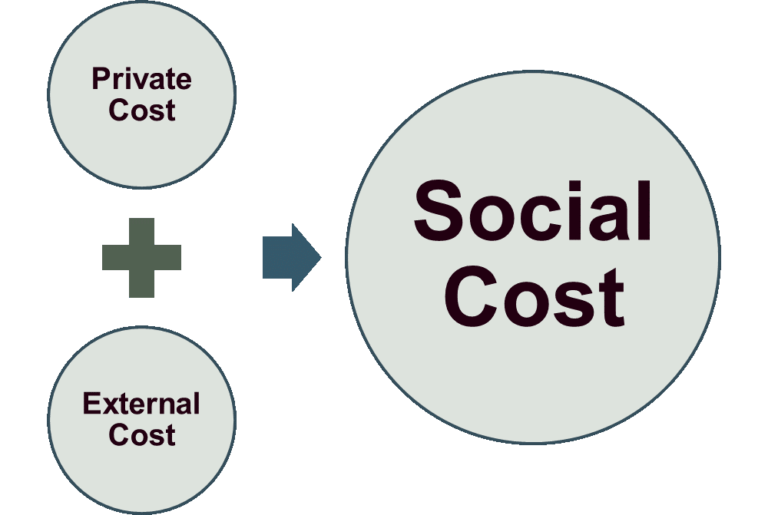
The costs incurred by economic agents as a result of the actions of other economic agents are called external costs, e.g. pollution from factories, delays caused by traffic congestion, etc. These costs are usually ignored by the decision-makers in the market economy. Normally, economic agents consider only those costs they incur directly in their production or consumption decisions; these are called private costs. Examples of private costs include rent, raw material costs, labour cost, transport cost and other costs that firms pay for. If firms had considered and valued external costs, their total costs would have gone up. And the result is that they would have reduced the quantity they produce because of increased costs. This is in agreement with the theory of supply- an increase in production costs reduces supply and shifts the supply curve leftwards. The sum of the private cost and the external cost is the social cost. Social cost represents the total cost of a decision.
Private benefits, external benefits and social benefits
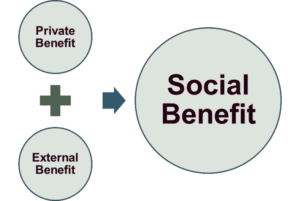
There are also positive consequences of production and consumption for third parties. These are termed external benefits. External benefits are the benefits derived by one economic agent from the action of another economic agent. These are also not accounted for by private economic agents because they are not directly affected. The firm derives sales revenue from its activities; this is a private benefit. Social benefit is the sum of private benefit and external benefit.
Types of externalities
Production externalities
Production externalities are spillover effects arising from production. The cost incurred directly by the producer in the manufacture of an extra unit of a product is Marginal Private Cost (MPC). Marginal External Cost (MEC) is the cost to a third party that arises from producing an extra unit of a product. The value of pollution created from making every extra unit of a product is an example of MEC. The private firm in a market economy does not pay MEC but pays MPC. The summation of MPC and MEC gives Marginal Social Cost (MSC). MSC is the total cost incurred in producing an extra unit of a product. It includes both the direct and indirect costs of producing an additional unit of a product.
MSC = MPC + MEC
Cost is a major determinant of supply. If all costs (social costs) are considered, firms will supply less. But if only private costs are considered, they will supply more. The MSC curve and MPC curve are upward-sloping curves like the supply curve of a firm. MEC is the difference between MSC and MPC and is the distance between MSC and MPC curves.
MEC = MSC – MPC
Negative production externalities
Negative production externalities are the adverse effects of production on third parties. Those who are not involved in production are affected without any form of compensation. Costs are imposed on other economic agents without any consideration by the price mechanism. If there are no externalities, MSC will be equal to MPC. Graphically, the MSC will be the same as the MPC. There will be only one upward-sloping curve. When drawing production externalities curves, an assumption that the Marginal Private Benefit (MPB) curve and the Marginal Social Benefit (MSB) curve are the same could be made. Both MPB and MSB curves are downward-sloping curves like demand curves since they represent consumption externalities.
If MEC = 0,
MSC = MPC
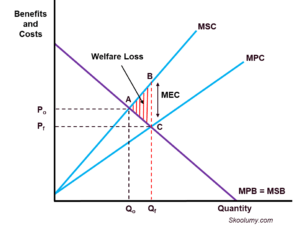
If there are negative production externalities, MSC is greater than MPC. Graphically, the MSC curve is above the MPC curve (Figure 1 below). The free market equilibrium is at C where MPB is equal to MPC and the free market equilibrium quantity is Qf. The social optimum quantity, which is the most desirable quantity for the society, is Qo from where MSB is equal to MSC. In this case, the free market produces more than what is best for the society; therefore, there is a welfare loss (deadweight loss) represented by the area of triangle ABC. The government can use taxation to ensure that the market reduces its quantity to Qo or close to it.
If there are negative production externalities,
MSC > MPC
Figure 1:Graph showing negative production externality
Positive production externalities
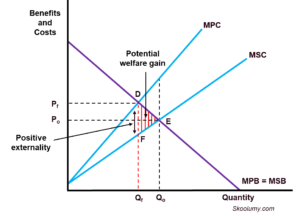
Positive production externalities are the third-party benefits from production. In this case, the MPC is greater than the MSC. The cost to the society is less than the cost to the individual firm; that is to say, there are benefits the society can obtain from the actions of the producing firm. Graphically MPC is above MSC. The free market equilibrium quantity Qf (where MPB = MPC) is less than the social optimum quantity Qo(where MSB = MSC). There is welfare to be gained (area of triangle DEF) if production can be increased to QO. The government could grant subsidies to firms to increase their supply to Qo.
If there are positive production externalities,
MPC > MSC
Figure 2:Graph showing positive production externality
Consumption externalities
These are the benefits or costs arising from consumption. Marginal Private Benefit (MPB) is the benefit derived from consuming an additional unit of a product while the benefit to another party when one party consumes an extra unit of a product is Marginal External Benefit (MEB). The total benefit derived from an extra unit consumed is Marginal Social Benefit (MSB). MSB is the addition of MPB and MEB. Consumption externalities curves are downward-sloping like the demand curve. It is assumed that the MPC and MSC are the same.
MSB = MPB + MEB
Positive consumption externalities
These are the benefits that another economic agent enjoys as a result of the consumption activity of an economic agent. In this case, there is a positive externality and MSB is greater than the MPB. The MSB curve is above the MPB curve (Figure 3 below). The difference (distance) between the MSB and MPB is the MEB or positive externality. The free market equilibrium quantity Qf is less than the social optimum quantity Qo. The society stands to gain welfare represented by the area of triangle GHI if the quantity consumed increases to Qo. A merit good is a good with a positive consumption externality, e.g. healthcare. The quantity consumed can be increased to the social optimum level through subsidies or direct provision by the government.
If there are positive consumption externalities
MSB > MPB
Figure 3:Graph showing positive consumption externality

Negative consumption externalities
Negative consumption externalities are the negative effects of the consumption of one economic agent on another economic agent. The MPB is greater than MSB. Therefore, the MPB curve is above the MSB curve. The product is overproduced as the free market quantity Qf exceeds the social optimum quantity Qo leading to a welfare loss shown by the area of triangle JKL in Figure 4 below. An example is a demerit good like alcohol with a negative consumption externality.
If there are negative consumption externalities,
MPB > MSB
Figure 4:Graph showing negative consumption externality

Government intervention in market failure
Direct provision
The government embarks on direct provision of public goods because they are not provided by the private sector. They are not attractive to the private sector because people can have access to them without paying. That is to say, they are non-excludable.
Also, the government can provide merit goods due to the inability of the free market to provide them in sufficient quantities and at affordable prices, e.g. public schools. Direct provision by the state increases government spending and may result in budget deficit. Government may have to borrow to finance the provision of these goods.
Taxes
A tax is a form of financial intervention by the government for goods that generate negative production or consumption externalities. The imposition of taxes is used to reduce the quantity of demerit goods produced or consumed in the economy. Demerit goods are often over-produced because the price mechanism does not consider the external costs they impose on third parties. The amount of the tax should be equivalent to the value of externalities generated by a producer that pollutes the environment or an individual that consumes demerit goods. Taxes will provide a way of internalising the external costs, reduce free market quantity and bring it as close as possible to the socially optimal quantity. The taxes are capable of reducing negative externalities and improving economic welfare. The major problem is the difficulty in accurately valuing external costs imposed by demerit goods. The elasticity of demand of the product also determines whether consumption will fall to the socially optimal quantity. Quantity demanded will fall slightly as a result of price increase caused by tax if demand in inelastic.
Progressive income taxes can be used to reduce income and wealth inequality. High income earners are required to pay higher tax rate. The taxes raised can be used to pay benefits to low-income earners or finance goods and services such as healthcare and education. High taxation can be a disincentive to work and benefits may not be claimed by those who need them.
Subsidies
Subsidies are financial incentives given in respect of goods with external benefits, e.g. merit goods. These goods are usually under-produced. The amount of the subsidy is the estimated value of the positive externality derivable form the product. Subsidies help to cover part of the cost of production, expand supply and drive down prices. If the product has an inelastic demand, price reduction will lead to a smaller percentage rise in quantity demanded. It in more effective for products with relatively elastic demand because a price fall will lead to a greater percentage rise in the quantity demanded. It is very difficult to correctly estimate the external benefits arising from consumption. Therefore, the amount of the subsidy may be inadequate or too much. In addition, a lot of finance is required to sustain the policy.
Regulation and deregulation
Regulation involves the use of standards, rules or laws to control the quantity and quality of products. Regulations can be used to reduce negative externalities such as the compulsory use of catalytic converters to reduce pollution generated from vehicles or pollution permits that limit amount of pollution businesses can produce. Regulations can also be used to encourage the use of goods with positive externalities, e.g. compulsory education. Antitrust laws, for instance, help control monopolies and encourage more competition in the market. The benefits of regulations must outweigh the administrative costs required to ensure compliance.
Deregulation means reducing the amount of regulations to promote competition and prevent the emergence of monopolies.
Provision of information
The government can prevent information failure through education, awareness campaigns and advertisements. This will ensure people are fully aware of the benefits or costs associated with the consumption of certain products. It will discourage over-consumption of demerit goods and encourage the consumption of merit goods. The costs involved must be weighed against the benefits. In addition, it may take time for them to have the anticipated impact.
Granting property rights
The government can grant the ownership of resources to firms or people so that actions can be taken to reduce negative externalities. For example, the ownership of a river can be granted to the community so that it can sue firms that pollute it. Property rights extension can lead to compensation of those who suffer from externalities.
Government failure
Government failure occurs when the intervention in the free market by the government does not correct market failure but leads to inefficiency. The intervention fails to correct inefficiency in the market and creates problem or economic welfare loss. The reasons for government failure are explained below.
Information failure
The government may not have adequate information to determine the appropriate amount of subsidies and taxes required to ensure the consumption of an adequate amount of goods in the economy. It has to value both external benefits and external costs from the information it gathers from different sources. This information may not be readily available. There may also be uncertainty about the consequences (positive or negative) of its policy intervention in the economy.
Disincentive of taxation
Progressive taxation, which is often used to redistribute income, may discourage hard-work since the higher the income the higher the tax rate. Indirect taxes, which are meant to reduce consumption of demerit goods, will reduce supply and raise prices. This will create a welfare loss (deadweight loss) because the desired production and consumption will not take place.
Political self-interest
The government sometimes makes decisions based on political considerations rather than economic considerations. It tries as much as possible to implement policies that are unpopular with the populace even if they are the most appropriate ones. The reason is to avoid being voted out of power in the next election. Therefore, the intervention does not correct the problem but leads to inefficient use of scarce resources.
Government bureaucracy
The lengthened administrative procedures in government make decision-making slow. The circumstances might have changed by the time the policy is approved and implemented. Bureaucratic bottlenecks make it hard for the government to respond to changes on time. It ends up implementing outdated policies that could worsen the situation.
Frequent changes in government policies
Frequent changes in government policies may create business uncertainty as firms cannot easily plan based on prevailing policies on taxation, price controls, subsidies and other areas of the economy. This affects the effectiveness of policies in tackling market failure.
Disincentive of subsidies
Many loss-making and inefficient businesses are subsidised at tax payers’ expense. Subsidies give the recipient firms an unfair advantage over competitors because their prices are much lower. Over-reliance on government subsidies breeds inefficiency as firms do not attempt to cut costs and improve supply on their own. Without subsidies, the firms could reallocate resources to areas where they are needed more.
Disincentive of welfare benefits
The payment of benefits to the poor and the unemployed, in a bid to reduce inequality, will reduce their effort to improve their skills and get a good job. They may also engage in risky behaviour, such as smoking, if they enjoy free healthcare from the government.
Unintended consequences
Government intervention may produce undesirable outcomes that were not anticipated when the policies were designed. Therefore, the policies may fail to correct the market failure they were intended to correct and create additional problems.
Short-termism
The government may use a short-term solution for an issue that requires a long-term solution. The policy may provide a temporary solution that does not address the underlying problem. It may be hurriedly designed and not well-thought-out. It may provide a short-lived reprieve before a total collapse is experienced. This leads to government failure. Short-termism is also called policy myopia.
Regulatory capture
This occurs when the government officials start working for the interests of the firms they are supposed to regulate but not the interests of the members of the public. The regulators build relationships with the firms over time and start supporting their actions instead of serving the interests of the consumers. In other words, they are not totally independent and could be pressurised to work in favour of the industry they are regulating. The regulators may also succumb to pressure to act in such a way that will further the political interests of the government in power; this may result in misallocation of resources.