What is demand for money?

Demand for money is the desire to keep liquid assets as against spending it on financial or physical assets such as bonds and real estate. People desire to hold cash because it is the most liquid asset. A liquid asset can be readily and immediately converted to cash with minimal loss of value. Demand for money is also known as liquidity preference.

According to John Maynard Keynes, a renowned English economist,  the three motives for holding liquid assets, for example cash, are:
1. Transactions motive;
2. Precautionary motive: and
3. Speculative motive.

Reasons for holding liquid assets

Transactions motive

This is the desire by an individual or a business to hold cash for regular or routine transactions, e.g. transportation or settling suppliers. This is because money is usually received periodically, for example monthly, but there are day-to-day expenses that have to be paid for. The determinants of transactions motive include:
1. The level of income or business revenue: The balance held will be large if income from employment or business is high.
2. Time gap between receipt of income and its spending: Less cash is kept for this purpose if income is received at a short interval, e.g. daily. 
3. Availability of credit products, e.g. credit cards, overdrafts, loans, etc.: It makes it easier to obtain loans, thereby reducing the need to keep a lot of cash for current transactions.

Precautionary motive

Some money has to be reserved in liquid assets because of uncertainty or unanticipated personal and business expenses e.g. sudden illness, default by a major customer, etc. The determinants of precautionary motive include:
1. The level of income: A larger income translates into more money being set aside for unforeseen expenditures.
2. Availability of credit products, e.g. credit cards, etc. This has been made possible by financial innovations.
3. Pessimism/ optimism by households or businesses: Optimism, for example, would lead to less balance being held for unexpected expenditure. Pessimism, on the other hand, requires more precautionary balance to prepare for the worst-case scenario because business is risky.

Speculative Motive

This involves holding cash to take advantage of changes in the prices of bonds or other securities. Speculative motive depends on expectations about future prices of assets or securities. If an individual expects the price of bonds to fall, he will keep more cash to buy when the price falls; therefore, the demand for money for speculative purpose will be high. 

Active and idle balances

The cash held for both transactions and precautionary motives are called active balances because they are available for spending. Active balances are used to pay for goods and services on a day-to-day basis or as they occur.

The money set aside for speculative motive is known as idle balance because it is usually stored until there is an opportunity to earn interest from buying bonds or other securities.

Interest elasticity and demand for money

The demand for money for transactions and precautionary motives are interest inelastic. That is to say, these balances are independent of interest rates. They do not respond to a change in interest rate. However, they are highly income elastic; they are directly related to income level since they rise as income rises and vice versa.

Money kept for speculative motive is inversely related to interest rate. The demand for speculative motive falls as interest rate rises and vice versa. For instance, more money will be invested in bonds if the interest rate on bonds is high, thereby reducing the cash kept for speculation. Bond prices are always low when the interest rate is high. This is possible because the demand for existing bonds will decrease if the interest rate rises, thereby depressing their prices.

Demand for money curve

The demand for money curve is a function of transactions, precautionary and speculative motives. The curve is downward-sloping, meaning that the total demand for money rises as the interest rate falls and falls as the interest rate rises. Financial system deregulation has made it easier to obtain loans for both transactions and precautionary motives. This means even transactions-cum-precautionary balance will drop if the interest rate is high. 

Figure 1: Demand for money curve
demand for money curve

A change in interest rate results in a movement along the curve. For example, an increase in interest rate from r1 to r2 causes a movement from A to B along the curve (Figure 1 above). A change in other factors, such as expectation, will cause a rightward or a leftward shift (Figure 2 below).

Figure 2: Shift in the demand for money curve
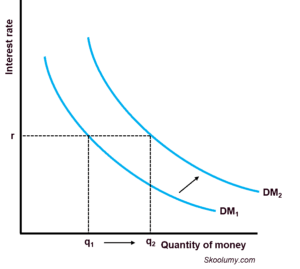
shift in demand for money curve