What is consumer surplus?
Consumer surplus is the difference between what a consumer is willing to pay and the market price. When consumer surplus exists, the total satisfaction exceeds the actual price paid for the good. The satisfaction derived from the consumption of a product is known as utility. Assuming utility or satisfaction can be measured in terms of money, the price paid is equivalent to the marginal utility, i.e. satisfaction from every extra unit consumed. But total utility or satisfaction is more than the marginal utility. There is, therefore, surplus satisfaction in consuming the product. If the total valuation/utility is $1.50 and the actual price or marginal utility is $1.00, the consumer surplus is $0.50 ($1.50 – $1.00).
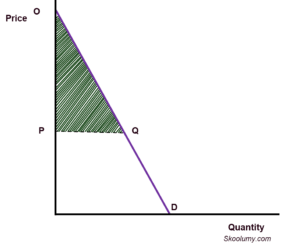
The amount the consumer is willing and able to pay is represented by the demand curve. The area below the demand curve but above the price is the consumer surplus. In Figure 1 below, consumer surplus is represented by the area of the triangle OPQ. Consumer surplus is a measure of consumer welfare; an increase in consumer surplus represents an increase in the welfare of the consumer as he derives a surplus amount of satisfaction from consuming the units of a product.
Figure 1: Consumer surplus
Numerical example of consumer surplus
Given the graph below, calculate the consumer surplus.
Figure 2: 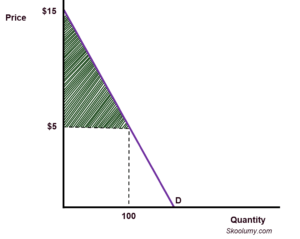
Consumer surplus,i.e. area of the shaded triangle = 1/2 x 100 x ($15-$5)
= $500
Consumer surplus and price elasticity of demand
The amount of consumer surplus is determined by the elasticity of demand. The elasticity of demand affects the slope of the demand curve and the area represented by the consumer surplus.
Fairly inelastic and fairly elastic demand
The amount of the consumer surplus for a fairly inelastic demand is larger than for elastic demand. The consumer is less responsive to a price change and is willing to pay more if his demand for a product is fairly inelastic. This may happen if the product is addictive, a necessity or has no substitute. Therefore, the difference between what he is willing to pay and the actual market price is high (see the first graph in Figure 3 below).
Figure 3: Fairly inelastic demand Fairly elastic demand

he consumer is more responsive to a price change if his demand for a product is fairly elastic. For example, a consumer is not willing to pay too much for a product with many substitutes; he is always ready to make a switch to a substitute if the price is raised. Therefore, the difference between what he is willing to pay and the market price is not large (see the second graph in Figure 3 above).
Perfectly inelastic and perfectly elastic demand
The size of the consumer surplus for perfectly inelastic demand is infinite as the consumer is perfectly unresponsive to price changes. In other words, the quantity remains the same no matter the price.
Figure 4: Perfectly inelastic demand Perfectly elastic demand
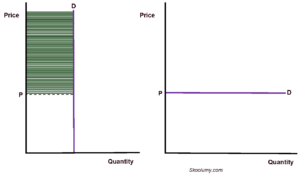
The price consumers are willing to pay as shown by the demand curve, coincides with the market price if demand is perfectly elastic. Therefore, the consumer surplus is zero as the difference between what the consumer is willing to pay and the market price is zero.
Change in consumer surplus
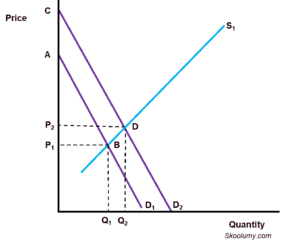
The amount of the consumer surplus changes when there is a change in the equilibrium price due to a change in demand or supply. In Figure 5 below, an increase in demand from D1 to D2 raises the equilibrium price from P1 to P2 owing to successful advertising. Consequently, there is a change in the consumer surplus from triangle AP1B to CP2D.
Figure 5: Effect of increase in demand on consumer surplus
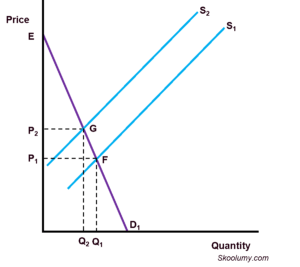
In Figure 6 below, a rise in the cost of production reduces supply from S1 to S2. The new equilibrium price is P2 and the consumer surplus decreases from triangle EP1F to EP2G.
Figure 6: Effect of decrease in supply on consumer surplus
What is producer surplus?
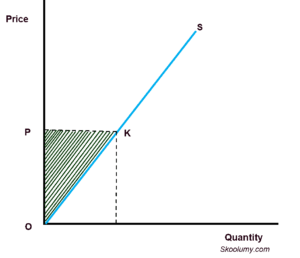
Producer surplus is the difference between the price producers are willing to accept for a product and the actual market price. It is a measure of the welfare of the producer and a rise means an increase in the producer’s welfare. The producer surplus is represented by the area above the supply curve and below the market price. In Figure 7 below, the producer surplus is the area of the triangle PKO.
Figure 7: Producer surplus
Change in producer surplus
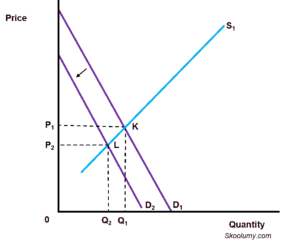
The amount of producer surplus changes as a result of a change in demand or supply. There is a new equilibrium price as a result of a change in demand or supply. Therefore, the area showing the producer surplus will increase or decrease. A decrease in demand caused by a reduction in income will shift the demand curve from D1 to D2 (Figure 8 below); the equilibrium price decreases from P1 to P2 and the equilibrium quantity reduces from Q1 to Q2. Consequently, the producer surplus decreases from P1KO to P2LO.
Figure 8: The effect of decrease in demand on producer surplus
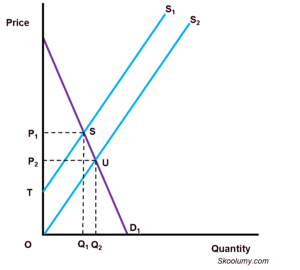
An increase in supply due to subsidy shifts the supply curve rightward from S1 to S2. The price decreased from P1 to P2 while quantity increased from Q1 to Q2. The producer surplus increases from P1ST to P2UO.
Figure 9: The effect of increase in supply on producer surplus