Circular flow of income and Gross Domestic Product (GDP)
The circular flow of income diagram also shows the level of economic activities or the output of the economy (GDP). GDP is measured by the output, income and expenditure methods. These three methods are shown on the circular flow of income diagram. Household expenditure on goods and services gives the GDP by the expenditure method; the goods and services flowing from firms to households produce the GDP by the output method while incomes paid to households by firms for use of productive resources amount to the GDP by income method (see Figure 5 below). The three methods should give the same value for the GDP of the country. Therefore,
National Expenditure = National Output = National Income
The national income in a two-sector economy is
Y = C + I
A three-sector’s national income is calculated thus
Y = C + I + G
The national income in a four-sector economy is given as
Y = C + I + G + (X-M)
Figure 1: A circular flow of income diagram showing different ways of measuring GDP

Equilibrium level of the national income
There is no tendency for the national income to change at equilibrium. This can occur when the injections and leakages in an economy are equal.
In a two-sector economy, equilibrium occurs when
I = S
The equilibrium in a three-sector economy is given as:
I + G = S + T
Equilibrium in a four-sector economy is
I + G + X = S + T + M
Figure 2: National income equilibrium in a four-sector economy

Disequilibrium occurs when injections and withdrawals are not equal. If injections are greater than withdrawals, there is a net inflow of income into the economy. Total spending will rise and aggregate demand will expand. The economy’s output will increase as firms respond to the rise in aggregate demand. More income will be paid for the use of productive resources of land, labour, capital and enterprise following an increase in output. The unemployment rate will decrease even though inflationary pressure may build up as aggregate demand outpaces aggregate supply. A rise in domestic inflation would reduce the competitiveness of a country’s exports, which may lead to a balance of payments deficit.
There is a net outflow of income if injections are less than withdrawals. More money will be removed from the income flow as a result of this. This will shrink aggregate demand and total expenditure in the economy. Jobs will be lost due to a decline in economic output. And there may be deflationary pressure as prices keep falling.
National income equilibrium and injections
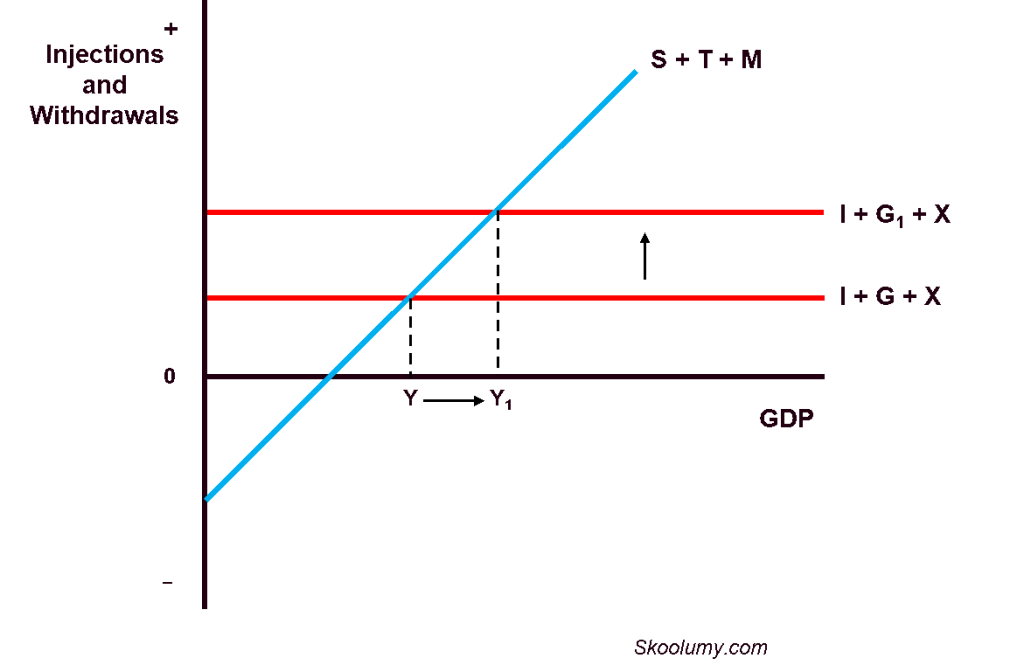
An increase in injection (I, G or X) will shift the I +G+X line upwards and raise the GDP or national income from Y to Y1 (Figure 3 below). For example, a rise in government spending (G) on infrastructure would boost investment and the total output of the economy. In addition, more incomes are earned by factors of production, which can be spent on goods and services in the economy.
Figure 3: Effect of a rise in government on equilibrium national income
A decrease in withdrawal, such as savings, will have the same effect as a rise in injection. More money is available for spending. The S+T+M line will shift downward, causing the GDP or national income to rise from Y to Y1 (Figure 4 below).
Figure 4: Effect of a fall in savings on equilibrium national income

National income equilibrium and withdrawals
A rise in withdrawals, such as imports, will shift the S+T+M upwards, resulting in a fall in the GDP or national income (Figure 5 below). This would have the same effect on GDP as a decrease in injection shifts the I+G+X line downwards.
Figure 5:Effect of a rise in imports on equilibrium national income
