What is Cost-Benefit Analysis?
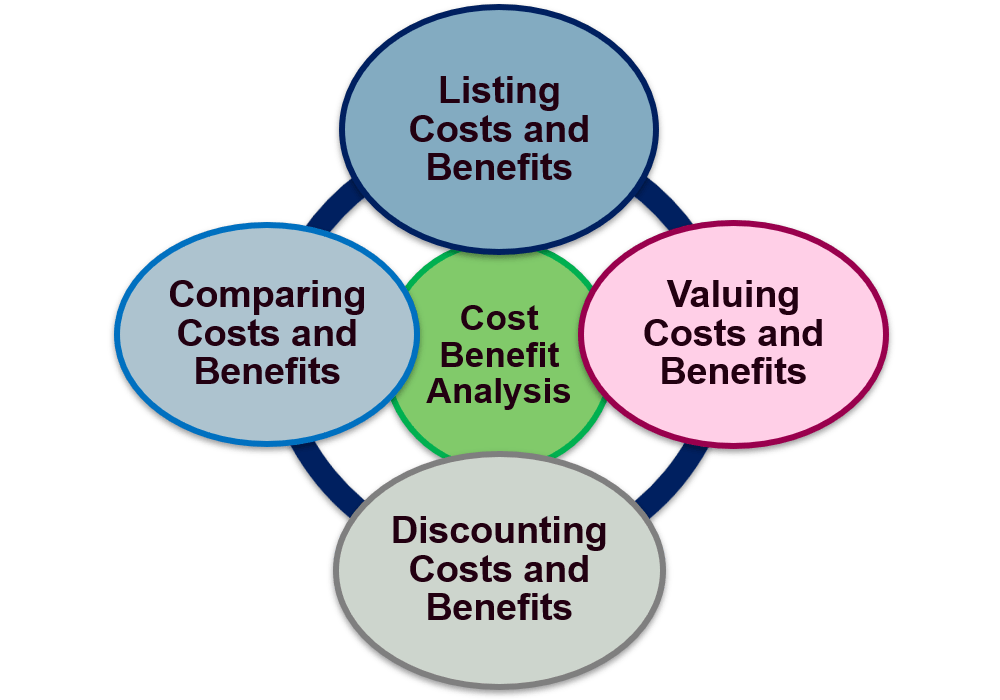
Stages of Cost-Benefit Analysis

Cost-Benefit Analysis (CBA) is a comprehensive method of evaluating projects by comparing the social (total) costs and social (total) benefits. Social cost, which is the total cost of a decision, is the sum of private costs and external costs. Social benefit, the total benefit of a decision, is the sum of private benefits and external benefits. If the social benefits exceed the social costs, the project is accepted. But if social benefits are less than the social costs, it is rejected.

For example,  the construction of a new stadium, in addition to generating revenue from ticket sales to the owner, can benefit others in the society by stimulating economic activities in the area, promoting tourism, expanding trade, attracting additional investment and increasing the visibility of the area. The costs to third parties in the society include noise pollution, air pollution, traffic congestion, loss of homes to people and wildlife. The third-party benefits are known as external benefits while the third-party costs are external costs. Both external benefits and external costs (externalities) are not considered by the owner of the stadium. 

Most private projects only weigh private benefits against the private costs. The impact of these projects on the society are ignored, causing a situation known as market failure. 

CBA is often used for public-sector projects such as the construction of bridges, schools, hospitals, and flood control systems. It may also be used by organisations in the private sector if they wish to have a comprehensive appraisal, since some projects have far-reaching consequences and are costly.

The steps involved in Cost-Benefit Analysis

CBA has the following steps: 

Listing all the costs and benefits

Firstly, total (social) benefits and total (social) costs associated with the project are itemised. The benefits are both direct (private) and indirect (external) benefits. An example of direct benefits is the revenue generated from a project or investment. Indirect benefit of a road project might include time saved in traffic, lives saved and expansion of economic activities. Costs include direct spending on equipment, labour, operations and maintenance. They also include indirect costs like traffic congestion, pollution, or other environmental damage.

Valuation of costs and benefits

The next step is assigning monetary values to benefits and costs. This is straightforward for direct benefits and direct costs, as there is a market for them. Therefore, we use their market prices, e.g., the market price of raw materials.

Indirect benefits and costs do not have markets and are difficult to value. For example, how do we assign values to clean air, or human life?  Therefore, externalities are assigned estimated values, known as shadow prices. These estimates are subjective and uncertain, and they are based on assumptions.

Discounting costs and benefits

Some investments or projects have costs and benefits extending to several years in the future. Discounting converts all future benefits and costs into what they are worth now (today), that is, their present values. Discounting is important because future values will be reduced by inflation. And it is not certain they will be realised as no one can accurately predict future values. A discount rate, which is difficult to determine, is used to convert all values to their present values.

Comparing costs and benefits

The total present value of costs are subtracted from the total present value of benefits to obtain a Net Present Value (NPV). A positive NPV indicates that discounted benefits surpass discounted costs and net welfare has increased. Net welfare decreases if the project has a negative NPV (discounted benefits are less than discounted costs). NPV can also be used to select the best among alternative projects. The project with the highest positive NPV is chosen as it is capable of producing the greatest welfare gain.

Another method of determining which project to undertake is Benefit–Cost Ratio (BCR), which divides the present value of benefits by the present value of costs. A BCR greater than 1 means that the project provides welfare gain because benefits exceed costs. A BCR of less than one leads to a welfare loss as costs exceed benefits.

Advantages of Cost-Benefit Analysis

Effect of a project on welfare

CBA helps determine whether there is a welfare loss or welfare gain from a project. If the estimated total benefits of a project outweigh the total costs, the project will improve welfare by benefiting the people and the environment. However, the project leads to a welfare loss if the total costs outweigh the total benefits. Projects with net welfare gain are accepted while projects with net welfare loss are rejected.

Without CBA, the indirect impacts of a project are often overlooked. CBA is a comprehensive analysis that forces decision-makers to consider the unintended effects and trade-offs of their decisions.

Efficient allocation of scarce resources

CBA is an objective method of determining which project deserves the allocation of resources. Projects can be compared and ranked using NPV or BCR; The project with the highest NPV or BCR gets the fund. It is data-driven and aids in prioritising projects

Transparency in handling projects

The data and assumptions used in CBA are clearly stated. This transparency helps hold decision-makers accountable. Independent parties can also verify whether government projects are truly beneficial to the public


Limitations of Cost-Benefit Analysis

Externalities are difficult to value

External benefits and external costs are difficult to express in monetary terms, e.g., danger to health from pollution. Assigning values to them requires a significant amount of judgement and uncertainty.

Externalities may last for years and extend beyond the community where the project is undertaken. They are usually underestimated because not all of them are captured and monetised.

Assumptions may be unreliable

The estimation of externalities, discount rate, etc., is based on assumptions. A small change in any of the assumptions may change the outcome of the analysis. 

Not everyone benefits

A project may have a net welfare gain without benefiting every group within the society. If a road project helps commuters (who are relatively better off) but forces the relocation of low-income residents, the net benefit could still be positive even though the poor are worse off.