Game outcome-Dominant strategy equilibrium
A dominant strategy is the best line of action for a player regardless of its competitor’s option. Table 1 below shows the payoff matrix for Company X and Company Y. The first number in each cell (red colour) is the profit for Company X while the second number (purple colour) is the payoff for Company Y if each decides to advertise or does not advertise.
Table 1: Payoff table for Company X and Company Y
To determine Company X’s strategy, one has to ascertain its best choice if Company Y advertises or does not advertise. If Y advertises, company X will make $20 if it advertises or $10 if it does not advertise. It will pick the option to advertise since it produces a higher payoff of $20 (see Table 2 below).
Table 2: Company X’s strategy if Company Y advertises
If Y does not advertise, company X will make $25 if it advertises or $15 if it does not advertise. It will choose the option to advertise since it produces a higher payoff of $25 (Table 3 below). Therefore, the dominant strategy of X is to advertise as it will always get a higher profit whether Y advertises or does not advertise.
Table 3: Company X’s strategy if Company Y does not advertise
Company Y’s strategy is the better option if Company X advertises or does not advertise. If Company X advertises, Company Y will make $15 if it advertises or $5 if it does not advertise. It will pick the option to advertise since it produces a higher payoff of $15 (Table 4 below).
Table 4: Company Y’s strategy if Company X advertises
If Company X does not advertise, Company Y will make $25 if it advertises or $10 if it does not advertise. It will select the option to advertise since it produces a higher payoff of $25 (Table 5 below). Therefore, the dominant strategy of Company Y is to advertise as it will always get a higher profit whether X advertises or not.
Table 5: Company Y’s strategy if Company X does not advertise
Game outcome-Nash Equilibrium
This occurs when a player has to choose his own strategy only after considering his competitor’s choice. A game may have no Nash equilibrium or more than one Nash equilibrium.
Table 6: Payoff table for Company X and Company Y
If Company Y advertises, Company X will make $20 if it advertises or $10 if it does not advertise. It will choose to advertise since it produces a higher payoff of $20 (Table 7 below).
Table 7: Company X’s strategy if Company Y advertises
If Company Y does not advertise, Company X will make $25 if it advertises or $30 if it does not advertise. It will pick the option not to advertise since it produces a higher payoff of $30 (Table 8 below). Company X has no dominant strategy. It will advertise if Y advertises; it will not advertise if Y does not advertise.
Table 8: Company X’s strategy if Company Y does not advertise
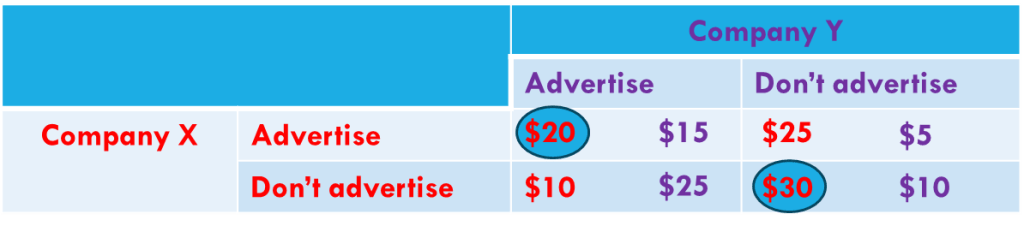
If Company X advertises, Company Y will make $15 if it advertises or $5 if it does not advertise. Company Y will pick the option to advertise since it produces a higher profit of $15 (Table 9 below).
Table 9: Company Y’s strategy if Company X advertises
If Company X does not advertise, Company Y will make $25 if it advertises or $10 if it does not advertise. Company Y will pick the option to advertise since it produces a higher payoff of $25 (Table 10 below). The dominant strategy for Y is to advertise.
The Nash equilibrium is the advertising strategy for both firms. This is where their strategies happen at the same time. It is shown by the star in Table 10. It is the best strategy or response for each, given the strategy of the other player. Neither can be better off in terms of profit by choosing a different option from the equilibrium.
Table 10: Company Y’s strategy if Company X does not advertise
Prisoners’ Dilemma
Prisoners’ Dilemma shows why firms in an oligopolistic market must cooperate for the best outcomes for all the players. However, each market participant is unsure of the other players’ courses of action. So they end up choosing an option that is not the most desirable for all of them. The Prisoners’ Dilemma explains one of the outcomes or consequences of Game Theory. In reality, firms are in a dilemma sometimes when making decisions. They may opt for a decision that may not be in their best interest owing to inadequate information about other players’ moves.
The Prisoners’ Dilemma was derived from the case of two persons accused of committing a crime. It can be illustrated with Table 1 below. The maximum jail term for any one of them who is found guilty is 8 years. The first number (in blue colour) in each table cell represents the jail term for Accused 1, while the second number (in black colour) is the jail term for Accused 2. If both of them deny the allegation, they will serve a term of 1 year each (for having incriminating material). But if only one of them confesses, he will be released, while the one who refuses to confess will be given the maximum jail term of 8 years. If they both confess, they will serve a reduced jail term of 3 years each. Obviously, the best outcome is for both of them not to confess and get a 1-year jail term each. The law enforcement agents understand that suspects can cooperate not to confess if they are in contact with each other. So they interrogate them separately. Each accused person is unsure if the other person will confess and be released, while he will be given the maximum jail term for failing to confess.
Table 1: Jail terms for Accused 1 and Accused 2
The choice available to Accused 1 will depend on the action taken by Accused 2. If Accused 2 confesses to the crime, the best option available for Accused 1 is to confess, which attracts a jail term of 3 years as against 8 years for not confessing. Accused 1’s strategy is to confess, since that will attract lesser punishment if the other accused person confesses (Table 2 below).
Table 2: The strategy of Accused 1 if Accused 2 confesses
If Accused 2 decides not to confess, Accused 1 is better off confessing since that attracts zero jail term compared to denying the allegation and getting a 1-year jail term (see Table 3 below). The dominant strategy for Accused 1 is to confess whether Accused 2 confesses or not.
Table 3: The strategy of Accused 1 if Accused 2 does not confess
The most desirable option for Accused 2 is to confess if Accused 1 confesses (Table 4 below). If he does not confess but Accused 1 confesses, he will be jailed for 8 years. He would rather confess and be imprisoned for a lesser jail term (3 years).
Table 4: The strategy of Accused 2 if Accused 1 confesses
If Accused 1 does not confess to the crime, Accused 2 will get zero sentence if he confesses and a 1-year term if he does not confess. The dominant strategy available for Accused 2 is to confess since he is unsure whether Accused 1 will confess. They are not allowed to communicate with each other.
The best outcome should have been a 1-year term for each if they both deny. Both of them will have to confess because neither can accurately ascertain the action of the other person. And if one suspect denies while the other confesses, the party who denies will get the maximum jail term, while the one who confesses will go scot-free. Therefore, it is better to confess and get 3-year term each.
Table 5: The strategy of Accused 2 if Accused 1 does not confess