What is Gross National Happiness?

GNH measures the happiness and welfare of the citizens. It is used to determine policy priorities and evaluate the effectiveness of government policies. Bhutan, a South Asian country of fewer than 1 million inhabitants, introduced Gross National Happiness (GNH) in 1972. The United Nations (UN) encouraged other countries to follow in the footsteps of Bhutan by not restricting the evaluation of the well-being of their citizens to economic indicators. Consequently, the UN declared March 20 as the International Day of Happiness. The Sustainable Development Solutions Network publishes the World Happiness Report annually, in conjunction with Gallup, WHR’s Editorial Board, and the Wellbeing Research Centre at the University of Oxford. The World Happiness Report ranks countries and cities based on factors that can impact happiness, including GDP per capita, social support, healthy life expectancy, freedom, generosity, and perceptions of corruption.

Gross National Happiness versus Gross Domestic Product

The Gross Domestic Product (GDP) is the most widely used measure of economic performance. GDP is a quantitative measure of the total output of an economy. An expanding GDP shows economic growth while a contracting GDP could indicate recession. However, GDP does not take into account many factors that promote the citizens’ welfare and make them happy. It does not adjust for the negative production externalities that can reduce the quality of life, e.g., air pollution. GDP does not help to determine whether people are poor or deprived of nutrients, water, education, healthcare, and a safe environment.

Gross National Happiness (GNH) takes into account many factors that affect welfare, like household per capita income, fundamental rights, wildlife damage, education, ownership of assets, sleep, mental health, emotions and community relationship. 

GNH Index

Bhutan uses a GNH index to track the happiness and well-being of its population. Other countries have similar indicators that can track economic progress in terms of the well-being of their citizens, such as the UK Measures of National Well-being. The GNH is based on four pillars and nine areas (domains).

The GNH is based on four pillars: good governance, sustainable and equitable socio-economic development, cultural preservation and environmental preservation. The domains are the means by which the pillars are measured.  Each domain has indicators that are tracked. For instance, the indicators under the psychological well-being domain are life satisfaction, positive emotions, negative emotions, and spirituality.
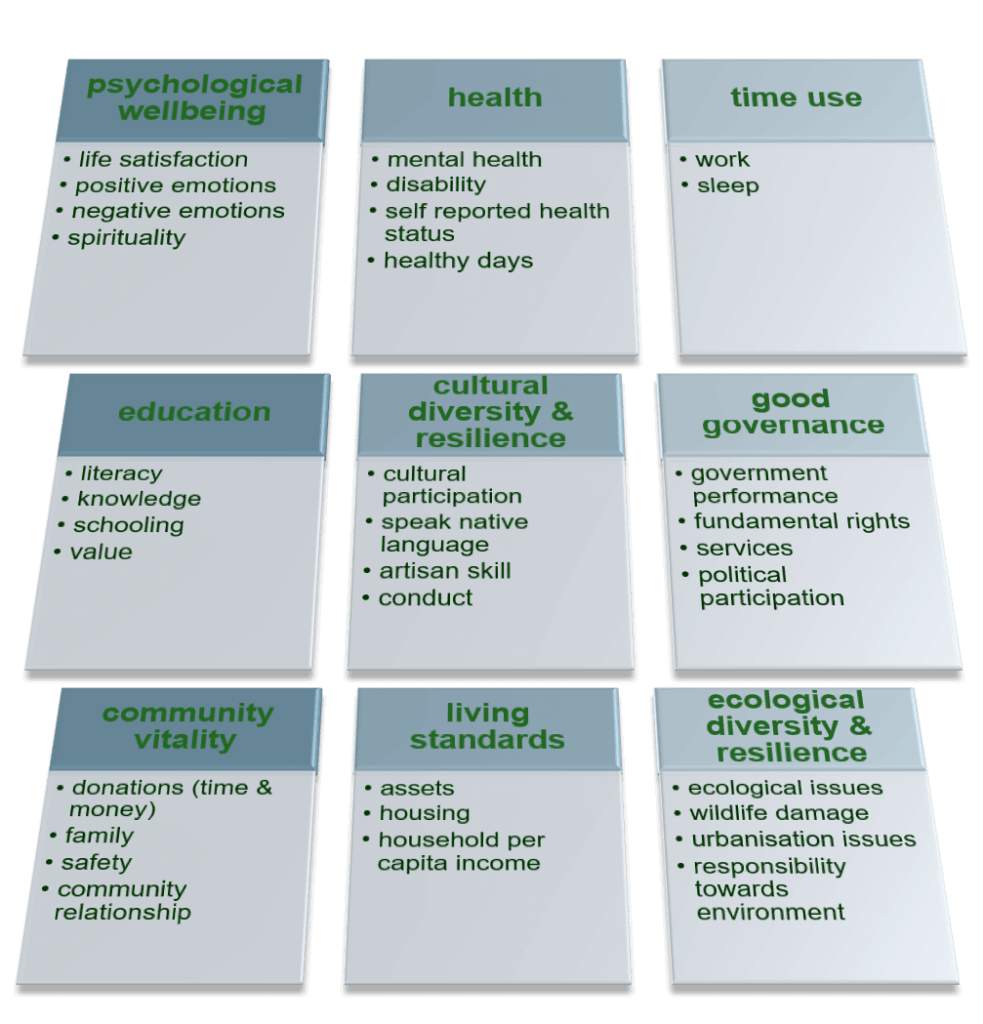
Domains of GNH Index