Meaning of inflation
Inflation is a continuous rise in the general price level of goods and services in an economy over a given time. The prices of most goods and services in the economy are on the increase in a period of inflation. One of the macroeconomic objectives of the government is to keep inflation under control because it leads to a fall in the value or purchasing power of money. Money loses value continuously in a period of inflation because the amount of goods that can be purchased with each unit of money decreases. An increase in the prices of products will lead to a fall in its purchasing power while a fall in prices will increase the value of money. This means that there is an inverse relationship between inflation and the value of money.
The cost of living is rising when the inflation rate is rising. The cost of living is a measure of what people spend on goods and services. The cost of living increases during inflation because people spend more on different products during inflation.
Disinflation versus deflation
A reduction in the rate of inflation is referred to as disinflation. For example, if the inflation rate in a country decreases from 10% to 8%, average prices are still rising, albeit at a slower rate. The general price level is increasing at a slower pace than before. However, deflation occurs when the inflation rate is negative. That is to say, most prices are falling and the general price level is on the decline when an economy experiences deflation.
How is the inflation rate calculated?
The rate of inflation is the percentage rise in the prices of goods and services bought by households over a period of time. It is usually made public every month and it shows the percentage rise over the previous twelve months. A very high inflation rate, say above 50%, is known as hyperinflation; hyperinflation makes money almost worthless. And people lose confidence in money as a medium of exchange and may resort to other means of exchange such as the barter system or the use of a more stable foreign currency such as a dollar. A low rate of inflation, say 2%, is known as creeping inflation.
Inflation can be measured through the Consumer Price Index (CPI) or Retail Price Index (RPI). The two methods of determining inflation use similar procedures but the products they cover are not exactly the same. CPI is a number that tracks changes in the average prices of a selected sample of goods and services consumers buy over time. In other words, it measures the average change in prices of a basket of goods and services over time.
The steps involved in measuring inflation are explained below.
(1) Select a base year
A year is chosen as the base year or reference year. It is compared with other years to ascertain the price change. And it is given an index of 100. If the CPI in a subsequent year is 110, it means inflation is 10% (110-100).
(2) A sample of products is selected
A sample of products that consumers normally buy is selected. This should be representative of what an average household buys, e.g., housing, transport, food, health, insurance, alcohol and tobacco.
(3) Weighting
The CPI is not a simple average because it is usually weighted by the proportion of total expenditure spent on each good or service. A survey is carried out to determine how an average family spends its money on each item. The weight assigned to each product shows its importance; for example, a bigger weight means the item accounts for a bigger proportion of the consumers’ spending.
(4) Prices are monitored
The prices of a range of products are monitored and collected on a regular basis and the average price is calculated for each product category. This is to ascertain the price change between the base year and the subsequent year.
(5) Multiply the weights by the price changes
Weight and price change for each product category are multiplied. The price change for each category is also known as price inflation for each category and it may be obtained by computing an index number using the formula below:
Current year price
—————————— X 100
Base year price
The price inflation/change for each category is the figure obtained from using the above formula minus 100 (index number for base year).
(6) Addition of weighted prices
The results of the multiplication of weight and price change for all the categories are totalled to determine the inflation rate. The new CPI is the inflation rate plus the base year index. For example, if the inflation rate is 5%, the new CPI is 105 (100+5). This means prices have risen by 5% over the base year. But if the inflation rate is to be calculated between two periods that exclude the base year, a percentage change in CPI between the two periods is calculated.
A numerical example on the calculation of inflation rate
| Product category | Average prices | Weight | ||
| Base year | Year 1 | Base year | Year 1 | |
| Food | $40 | $50 | 300 | 400 |
| Clothing | $30 | $25 | 150 | 180 |
| Alcohol & tobacco | $10 | $15 | 70 | 50 |
| Transport | $25 | $30 | 200 | 150 |
| Housing | $12 | $15 | 100 | 80 |
| Miscellaneous | $20 | $24 | 180 | 140 |
| Total | 1,000 | 1,000 | ||
Calculate the inflation rate in year 1.
Solution:
| Product category | Weight | Percentage of total spending | Price inflation | Weight x price inflation |
| Food | 400 | 40% | 25% | 10% |
| Clothing | 180 | 18% | -16.67% | -3.0% |
| Alcohol & tobacco | 50 | 5% | 50% | 2.5% |
| Transport | 150 | 15% | 20% | 3% |
| Housing | 80 | 8% | 25% | 2% |
| Miscellaneous | 140 | 14% | 20% | 2.8% |
| Total | 1,000 | 100% | 17.3% |
N.B.:
Percentage of total spending on food = 400/1,000 x 100 = 40%
Price inflation for food
Price index for food 50/40 x 100 = 125
Price inflation for food = 125 -100 = 25%
Weight x price inflation (food) = 0.40 x 25% = 10%
Limitations of the Consumer Price Index
Inflation cannot be measured accurately due to the following reasons:
It does not consider change in quality
Producers, in response to changing consumer wants, may add additional features to their products. If they raise prices due to improvements in product quality, inflation rate will be overstated as there is actually no inflation in this case. It is often difficult to make adjustment for the impact of quality improvements on the price of products. So quality is entirely ignored or not fully accounted for.
The sample may be unrepresentative
A sample of goods and services that a typical household buys is selected. This may not really reflect the spending patterns of the people in a country. What people buy is determined by taste, income level, gender, family circumstances and age. Some items may not be applicable to some households. For example, not everyone owns a car and car-related expenses are not incurred by every household; its inclusion in the CPI is misleading.
Importance of each product category differs
The relative importance of different products is manifested in the weights assigned to them. The weights used in CPI calculation may be wrong due to the fact that the importance attached to each product by different households differs. A weight of 50%, for instance, for food means that 50% of the expenditure of an average family is spent on food. This may be appropriate for low-income families but inappropriate for families with high incomes. This is because low-income households tend to spend a greater proportion of their incomes on food, while high-income earners spend a smaller percentage of their incomes on food. But there are certain things that high-income earners spend more on, e.g., household products and recreation.
New products are not quickly included
The products included in the calculation of inflation are reviewed from time to time. But it takes time for new products to be considered. New and popular products are not included immediately, thereby making inflation measurement inaccurate. Also, there may be a change in consumer taste or the availability of cheaper alternative products during the period. This is not usually captured in the inflation calculation in the period. Information on what consumers buy is not readily available.
Data collection error
Surveys are carried out to determine what people buy and how their incomes are spent on different products. There may be thousands of items involved. Sample selection may be prone to error, leading to the selection of items that do not represent what the whole population spends on. In addition, the collection of data, such as prices, is susceptible to errors and omissions.
Causes of inflation
There are two main causes of inflation, namely rising aggregate demand and rising costs of production.
Demand-pull inflation
This type of inflation arises when aggregate demand increases faster than aggregate supply. It means that the total demand increase in the economy has surpassed total supply of goods, thereby causing prices to be raised. Aggregate demand rises if any of its components (consumption, investment, government spending and net export) rises. For example, a rise in income would increase consumption and aggregate demand since consumption is a component of aggregate demand. Aggregate demand increases from AD1 to AD2 (Figure 1 below); the price level increases from P1 to P2 indicating that there is inflation. Other factors that can expand aggregate demand include low interest rate, consumer confidence, a fall in exchange rate and business confidence. Any of these factors will increase a component of aggregate demand.

Cost-push inflation
It is caused by a hike in the costs of production, e.g., energy cost, wages and salaries, raw material costs, etc. When costs rise, producers respond by increasing their prices, thereby fuelling inflation. Suppliers will reduce their supply when costs are rising; cutting down supply in the economy will increase the general price level. In Figure 2 below, aggregate supply decreases from AS1 to AS2, thereby causing inflation by raising the price level from P1 to P2. Cost-push inflation tends to be worse than demand-pull inflation due to the effect on total output in the economy. For cost-push inflation, a reduction in aggregate supply reduces the economy’s output of goods and services (from Y1 to Y2 in Figure 2 below). Demand-pull inflation, on the other hand, expands the total output of the country (from Y1 to Y2 in Figure 1 above). This is why cost-push inflation is often referred to as bad inflation, while demand-pull inflation is called good inflation.

Advantages of inflation
Encourages business investment
A low and stable rate of inflation encourages people to buy now rather than postpone their purchases. Since prices are rising continuously, it is better to buy now than later. This increases demand for goods which in turn stimulate investment in order to meet up with the demand.
Creation of jobs
Jobs are created when firms increase their investment in response to high demand. More people are able to earn incomes and government spending on benefits will nosedive.
Reduces real cost of borrowing
The real cost of borrowing is interest rate minus inflation rate. If inflation rate goes up, the real interest rate goes down. For example, the interest rate a borrower actually pays is 5% (15%-10%) if nominal interest rate is 15% and inflation is 10%.That means has reduced the value of the interest rate by 10%. This can encourage more borrowing for consumption and investment.
Leads to economic growth
Increased demand will encourage increased production, thereby increasing the output of products in the economy. In other words, more consumption and investment will promote economic growth.
Disadvantages of inflation
Current account deficit
A sustained rise in the prices of goods and services make domestic products less competitive in the international market, especially when other countries have a relatively lower inflation rate. Therefore, exports will reduce causing current account deficit.
Lower standard of living
Inflation increases prices of food and other essential products. This reduces purchasing power as products become expensive for people. The consequence is lower living standard in the economy.
Reduces investment
High and unstable inflation rate makes it difficult for businesses to predict costs and adjust prices accordingly. This breeds business uncertainty that discourages further investment and reduces employment opportunities in the country.
Discourages savings
Inflation reduces the value of money people have in their savings accounts unless the interest rate exceeds inflation rate. It discourages savings; less savings will reduce the availability of funds available in financial institutions to be channelled towards investment. People also spend time and money shopping for higher interest rate by moving from one financial institution to another. The cost involved in moving funds due to inflation is known as shoe-leather cost.
Rising labour costs and fiscal drag
Rising inflation rate leads to workers negotiating pay rise in order for their wages to keep pace with inflation. This increases labour costs and business profits. A pay rise “drags” people into a higher tax bracket where a progressive tax system is practised. Government tax revenue increases but pay rise is just to cushion the effect of inflation; people are not richer but they end up paying more taxes to the government.
Discourages lending
Lenders suffer in a period of inflation because they receive money with lesser value when repayment is made by borrowers. This may encourage them to increase interest rate on loans to reduce the adverse effect of inflation when repayment is made. Higher interest rate reduces borrowing and investment.
Fixed income earners suffer
People on fixed incomes, such as pensioners, will see the value of their income reduced considerably. This affects their purchasing power and makes them poorer.
Businesses incur additional costs adjusting to inflation
Inflation necessitates adjustment in prices by businesses in order to maintain their profit margins. They have to make changes to their price lists, catalogues, advertisements to reflect the new prices. This involves extra cost and may reduce profitability especially when the products have fairly elastic demand. These costs of making adjustment are called menu costs.
What is deflation?
Deflation is a continuous fall in the general price level of goods and services in an economy over a given time. It is the opposite of inflation as the inflation rate is negative. The prices of most goods and services in the economy are on the decline in a period of deflation. The general price level decreases continuously when there is deflation. And the value of money increases because the amount of goods that can be purchased with each unit of money increases.
Causes of deflation
Decrease in aggregate demand
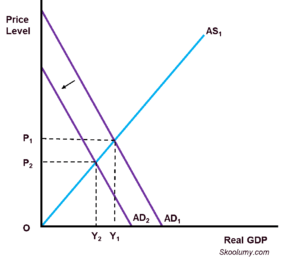
Aggregate demand comprises consumption, investment, government spending and net exports. A decrease in any of these components will lead to a fall in aggregate demand. For example, a rise in interest rate will reduce consumption and investment, thereby reducing aggregate demand. A decrease in aggregate demand will shift the aggregate demand curve to the left; this will reduce the price level and cause deflation. In Figure 1 below, aggregate demand decreases from AD1 to AD2 resulting in a decline in the price level from P1 to P2. This kind of deflation is more severe because output in the economy falls (from Y1 to Y2). Declining prices make people to start postponing their purchases; sales revenue of firms will keep falling and firms will cut down their output. This makes many workers to lose their jobs. That is why this type of deflation is also known as bad deflation. From the graph below
Increase in aggregate supply
Another cause of deflation is a rise in aggregate supply. Aggregate supply can increase due to technological advancement, increased productivity, falling production costs and rising competition. When there is technological advancement, for instance, more efficient machines are produced which can raise total supply and shift the aggregate supply rightwards. The aggregate supply increases from AS1 to AS2; the price level declines from P1 to P2, thereby causing deflation (Figure 2 below). This kind deflation raises the economy’s output (from Y1 to Y2) and is often referred to as good deflation.

Advantages of deflation
It creates employment opportunities
If deflation is caused by an increase in aggregate supply, output in the economy will rise. More workers are needed to expand the economy’s output. This reduces the unemployment rate and generates income for the workers to purchase more goods and services.
It improves the standard of living
The value of money increases when there is deflation. This means that more goods and services can be purchased with each unit of money. People’s standard of living, as a result, rises because they can meet more of their wants.
Lending is encouraged
Lenders gain as they receive money with more value when paid. They will be encouraged to increase lending, which leads to increased consumption and investment.
Total savings will increase
When there is deflation, the value of money in savings accounts keeps rising. Therefore, people are encouraged to save more. The savings ratio will rise as more households continue to save. Greater total savings make more funding available for investment, which assures of higher economic growth.
It lowers costs
When deflation is a result of technological improvement or increased productivity, costs are going to drop. Lower costs of production result in better profit margins for the business. Firms can pass on the benefit to consumers by lowering prices.
It encourages exports
Falling domestic prices will make exports price-competitive in the international market. More sales revenue would be realised due to an increase in exports. In addition, the current account deficit of the country can be reduced.
Disadvantages of deflation
Loss of jobs
Consumers keep postponing their purchases due to a continuous fall in prices. There is less revenue for firms. Less sales revenue means firms may have to lay off workers because output will decrease.
Borrowers lose
Borrowers lose because they have to pay back money with more value. It means that the real cost of borrowing (interest after adjustment for inflation) will increase. Borrowing by households and businesses will be reduced. Economic growth will be hampered as consumption and investment decline.
It reduces profits
Sales revenue of firms would decrease because consumers delay their purchases hoping that prices would continue to drop. Profits, as a result, diminishes and there would be reluctance to make further investment.