A two-sector economy
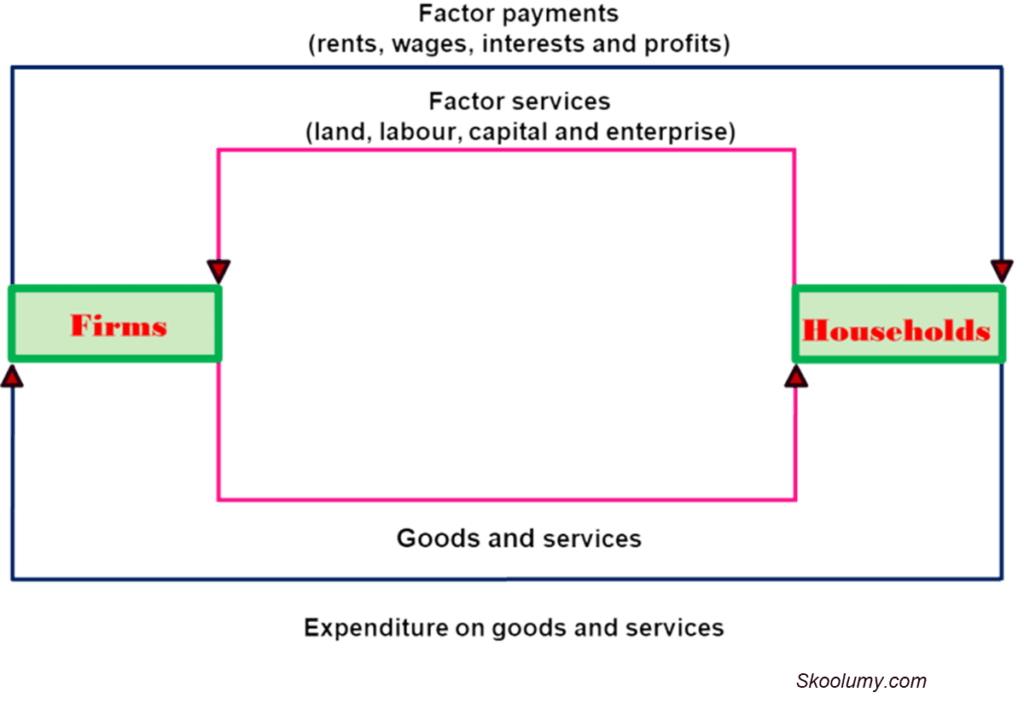
A two-sector economy is the simplest model and it is made up of two economic agents. The agents or participants are households and firms. The households, which comprise individuals, buy goods and services from the firms (businesses) and make payments for those goods. The goods and services flow from the firms to households (see Figure 1 below). Money flow from households to firms as expenditure on goods and services (see Figure 1 below). Also, households supply firms with their productive resources (land, labour, capital and enterprise) in return for incomes which are rents, profits, interests, wages and salaries.
This model assumes that all the income received by households is spent on goods and services and the same flow around the economy. Firms also pay out all money they receive from product sale as factor payments to domestic households.
Figure 1: A circular flow of income diagram for a two-sector economy without injection and leakage
In reality, not all incomes generated in the economy pass through the circular flow and not all incomes in the flow are generated locally. Some incomes are withdrawn from the income flow (withdrawals/leakages) while additional income may come from outside the economy (injections).
A modified two-sector economy with injection and withdrawal
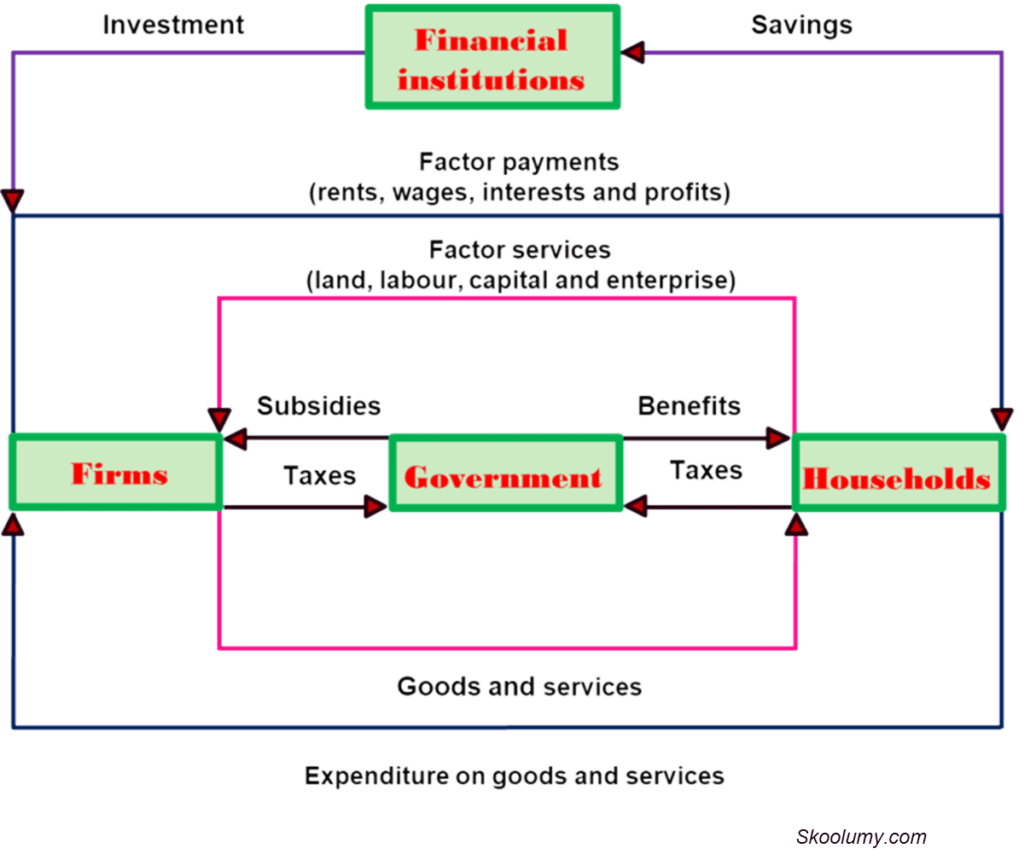
This is an improvement on the two-sector model. The injection in a two-sector economy is investment from firms (Figure 2 below). Money for investment is from financial institutions that obtain savings from economic units that have surplus funds and give them as loans to those economic units that need funds. The withdrawal or leakage here is savings, part of income that is not spent.
Figure 2: A circular flow of income diagram for a two-sector economy with injection and leakage

A three-sector economy
A three-sector economy is made up of three players, namely households, firms, and the government. The introduction of government means that there will be an additional injection (government expenditure) and an additional withdrawal (taxes). Therefore, the injections in a three-sector economy are investment and government spending, while the withdrawals are savings and taxes (Figure 3 below).
Figure 3: A circular flow of income diagram for a three-sector economy
A four-sector economy
It comprises four sectors, namely households, firms, government and foreign sector. The foreign sector is the trade sector and it is made up of exports and imports. The injections in a four-sector economy are investment, government spending and exports; the leakages/withdrawals are savings, taxes and imports (Figure 4 below).
A two-sector or a three-sector economy is known as a closed economy while a four-sector economy is an open economy. A closed economy does not engage in foreign trade but an open economy is involved in trade with other countries. The four-sector economy is a model of a modern economy as there is no economy that is totally isolated from others in terms of trade.
Figure 4: A circular flow of income diagram for a four-sector economy
