Protectionism policies
Tariff
A tariff is a tax on a good imported into a country. It is imposed in order to raise the price of an imported good and encourage consumers to switch to relatively cheap domestic goods. Tariffs also generate some revenue for the government.
In Figure 1 below, free trade leads to a drop in price from PD to PW; the total demand in the economy increases from QD to QWD while the quantity supplied by domestic firms falls from QD to QWS. The quantity imported is from QWS to QWD. The imposition of tariff moves the world supply upwards, with price rising from PW to PT. The total quantity consumed in the economy reduces from QWD to QTD while the domestic supply increases from QWS to QTS. The quantity of the good imported is now from QTS to QTD.
Figure 1: The effect of tariff

The imposition of tariffs on goods coming from other countries can lead to retaliation. Other countries will respond by imposing tariffs on the goods coming from that country too. It may result in a trade war and revenue loss for exporting firms. Also, tariff makes consumers suffer because they end up paying a higher price for the imported product.
In Figure 2 below, there is a loss of consumer surplus of PTPWGC (from APWG to APTC) due to tariff. Producer surplus, however, increased by the area PTPWDB (PTOB minus PWOD). The government gains tax revenue of BEFC from tax on imports. The welfare gain to the economy is the addition of the consumer surplus, producer surplus and tax revenue. In this case, the total welfare loss is represented by both BDE and CFG, i.e., loss in consumer surplus plus gain in producer surplus plus tax revenue.
Figure 2: Total welfare loss from tariff

Quota on imports
It is a limit on the amount of goods to be imported by a country. The good is not allowed to be imported after the quota is reached within a specified period of time. Alternatively, the government may impose a higher tariff on imports above the set limit. Quota reduces the amount of cheaper imports coming into a country to compete with locally made products. Thus, it protects domestic suppliers against foreign competition. The price will increase owing to the reduction in the amount of the product available. Quota is capable of correcting adverse trade balance by reducing imports.
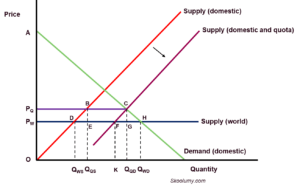
In Figure 3 below, if there are no trade barriers, consumers will pay price PW and the amount of imports will be the difference between QWD and QWS. A quota (F minus D) was introduced by the government. The introduction of the quota shifts the domestic supply curve rightwards. Price increases from PW to PQ and the quota reduces imports to the difference between K and QWS. But the imports are priced higher at PQ and imports revenue is PQ times quota (K-QWS). The quantity supplied by domestic firms increases from QWS to QQS. Domestic suppliers gained due to the higher price and higher quantity sold; their revenue increased from PwOQWSD to PQOQQSB. The government does not lose revenue as a result of the quota.
The consumer surplus falls by the area PQPWHC. The domestic suppliers gain a surplus of PQPWDB. Area BDE is part of the extra revenue gained by domestic suppliers because they are supplying more at a higher price. Area BEGC, part of the consumer surplus lost, is part of the revenue going to importers. The net welfare loss (deadweight loss) to the economy is represented by the area CGH.
Figure 3: The effect of import quota
Voluntary export restraint
An agreement is reached by an importing country with an exporting country to limit the amount of goods sent to the importing country. Voluntary export restraint may be arranged between governments or industries. This measure provides some protection for the domestic industry of the importing country. Unlike tariffs, it creates less friction between countries since it is voluntarily agreed upon. However, it could encourage the exporting country to establish manufacturing facilities in the importing country as a way of avoiding the restriction.
Export subsidies
These are forms of assistance given to domestic firms to encourage them to increase production and lower the prices of the goods for export. Export subsidies may be in the form of finance, low-interest loan or tax relief for domestic firms involved in the export of goods. This policy promotes exports as exports are price competitive in the international market. It restricts imports and reduces the current account deficit.
Export subsidies are costly to the government as the money could be directed to other projects in the country. In addition, continuous reliance on this kind of support by exporting firms engenders inefficiency because they will be reluctant to explore the avenues of cutting their costs and improving product quality. It can also lead to international tensions because other countries may see it as a way of giving an unfair advantage to certain industries in a country and putting their own domestic industries at risk. Other countries may retaliate by imposing barriers on imports of such subsidised products coming into their country.
Devaluation
A country can intentionally lower the value of its currency in terms of another currency in order to make its exports cheaper and imports dearer. It increases the volume of exports and reduces the volume of imports. This can fuel inflation in a country that imports raw materials and components.
Red-tapism
This is an administrative barrier meant to discourage imports. The government introduces a bureaucratic bottleneck that complicates and delays imports by imposing procedures, standards, requirements or rules.
Embargo
This is a ban on the importation of a particular product. It is used to protect domestic industries or products against foreign competition. Embargoes can protect infant industries from being suppressed and preserve domestic jobs. The government loses the tax revenue that would have been collected if it had imposed tariffs instead.
Foreign exchange control
The government can limit the availability of foreign currencies in order to curtail importation. Importers have to obtain the currencies of the exporting country for payment purposes. If foreign exchange is scarce, there will be fewer imports. This may be harmful to a growing economy that depends on other countries for raw materials, machines and spare parts.