Types of returns to scale
The following are the three types of returns to scale:
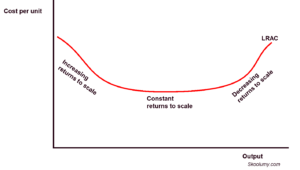
Decreasing returns to scale
This occurs when a percentage change in all inputs leads to a smaller percentage change in the output of the firm. It is decreasing returns to scale if, for example, a 10% increase in all inputs results in only 5% increase in output. The unit cost of production will rise as inputs rise faster than output.
Increasing returns to scale
Sometimes, an alteration of all inputs results in a greater change in output and cost per unit of output falls. Unit cost declines due to the availability of more units of output to absorb the input costs. A 20% jump in output following a 10% boost in all inputs is an example of increasing returns to scale.
Constant returns to scale
A change in all inputs results in an equivalent change in output. For instance, a firm’s output goes up by 10% owing to a 10% rise in all its inputs. Average cost or unit cost remains unchanged as inputs and output increase in the same proportion.
Figure 1: Long Run Average Cost Curve showing returns to scale