A numerical example
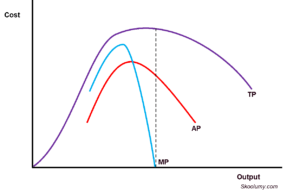
The law of diminishing returns sets in when the marginal product begins to drop. In Table 1 below, the law started when the 4th worker was employed, as the marginal product was reduced from 30 to 28 units. The average product will later start to decrease as can be seen in the table. The total product was actually increasing at a decreasing rate and it was at the maximum level when the marginal product was zero. The total product begins to fall when the marginal product is negative. This is illustrated in Figure 1 below.
Table 1: Illustration of the law of diminishing returns
| Capital | Labour | Total Product | Average Product | Marginal Product |
| 3 | 0 | 0 | – | – |
| 3 | 1 | 10 | 10 | 10 |
| 3 | 2 | 30 | 15 | 20 |
| 3 | 3 | 60 | 20 | 30 |
| 3 | 4 | 88 | 22 | 28 |
| 3 | 5 | 115 | 23 | 27 |
| 3 | 6 | 115 | 19.2 | 0 |
| 3 | 7 | 105 | 15 | -10 |
| 3 | 8 | 80 | 10 | -25 |
Figure 1: Total Product, Average Product and Marginal Product
The law of diminishing returns forms the basis of the short-run costs
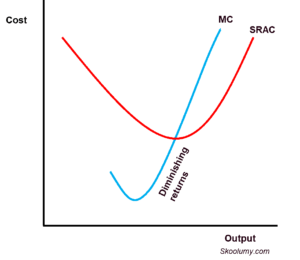
The marginal cost will fall in the beginning as each additional unit of the variable factor (worker) produces more than the one before it. And there is a larger increase in output than costs as one more factor unit is employed. It will get to a point where the productivity of the additional factor unit will begin to decline, leading to a rise in marginal cost (see Figure 2 below). This is when diminishing returns begins as there is no enough additional output to cover the additional cost associated with utilising the extra factor unit. Then the average cost, as well, begins to rise as the marginal cost rises; the total costs are increasing, but there is less marginal product, so the rate at which output increases is falling.
Figure 2: Short-run costs